I’m a musician from Dublin, Ireland. I also do contract work as a computer music designer. Download and use anything you want from this site. Feel free to get in touch with questions! I also have A NEW BLOG!
[Web]Radio Music
(2026)
[6]
web installation (realisation of John Cage's Radio Music)
[Web]Radio Music
(2026) [6]web installation (realisation of John Cage's Radio Music)
![Cover image for [Web]Radio Music](/media/work_covers/Screenshot_2026-05-30_at_18.34.40.png)
This is a realisation of John Cage's famous piece Radio Music, using the score to play back from a list of web radio stations rather than the originally intended AM hectohertz (!!) frequencies. The list of stations is one I found somewhere online, and I have not filtered or re-ordered it other than to include only French and Irish stations, so as to preserve the indeterminacy that comes with attempting to find specific frequencies on a real radio.
Another approach to digitising this piece is detailed in a paper by Lindsay Vickery (in that case, adapting it for use with DAB radio signals). Vickery's interpretation of the score's instructions is quite different to mine (I read it as intending you to stay on the notated frequency at the radio's maximum volume, so that is what I have programmed)
Radio Caroline and the Mi Amigo (devised with Cindy Cummings)
(2025)
[20]
devised piece for dancer, amplified viola with microscope, radios and DIY radio transmitters
Radio Caroline and the Mi Amigo (devised with Cindy Cummings)
(2025) [20]devised piece for dancer, amplified viola with microscope, radios and DIY radio transmitters
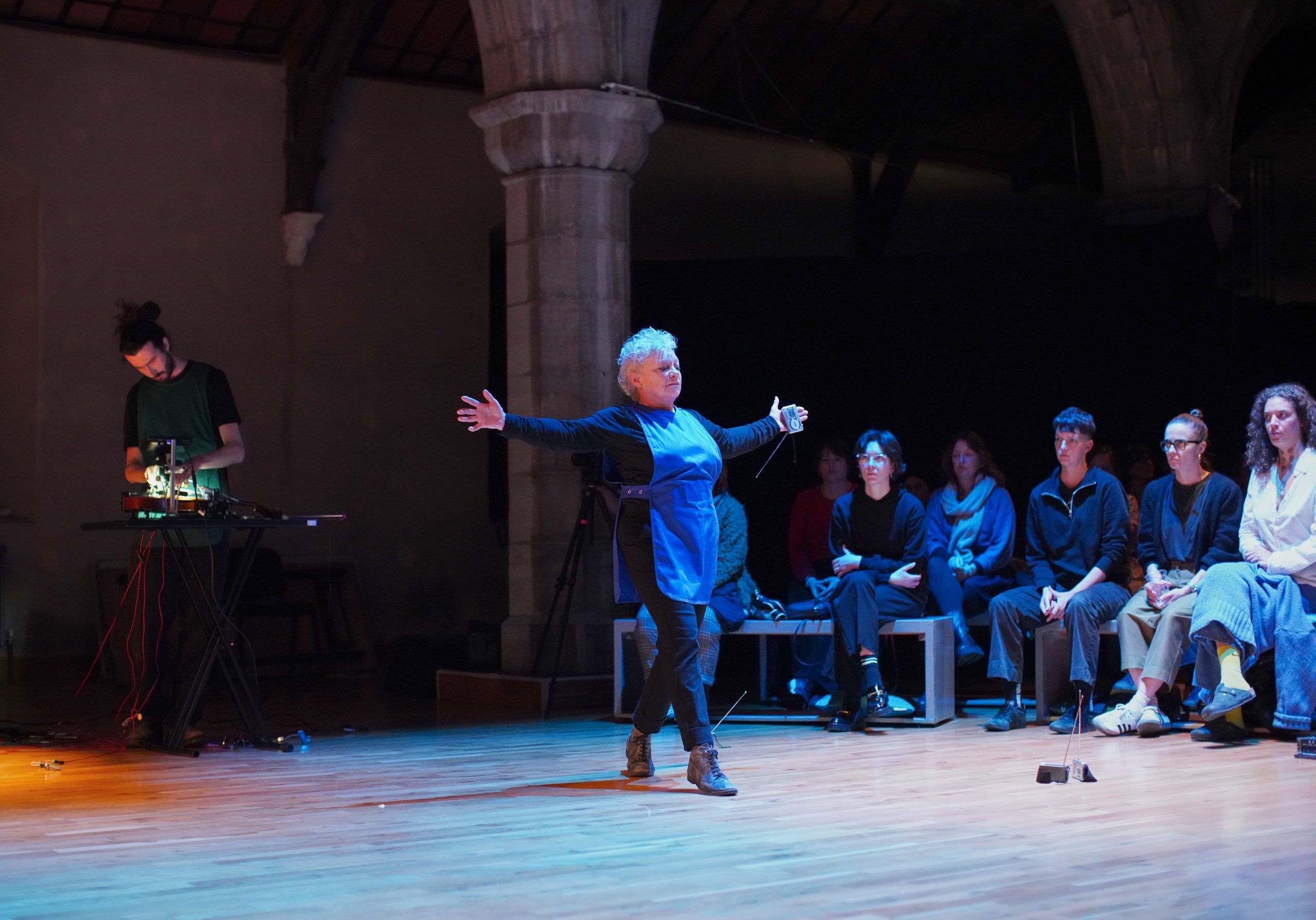
Using dance, video collage, DIY radio transmitters and portable radios, composer, viola player and artistic director Sebastian Adams and dance artist and choreographer Cindy Cummings navigate the spiritual legacy of Radio Caroline in a live, improvisational, experimental documentary. Radio Caroline was founded by an Irish businessman in order to circumvent the BBC’s broadcast monopoly and refusal to play modern pop music. The solution: a radio station in international waters. It became a beacon for pirates everywhere, a kick in the face to the copyright system, but also a money-making venture motivated more by opportunism than by ideology. As the old systems for policing and managing intellectual property and freedom of speech collapse around us, the voices of pirates are nowadays attempting not only to wrest media from the grips of their owners, but also to fight against new apparatus for mass surveillance.
Commissioned by: Light Moves Festival
[all] [electronic] [improvisation] [gig] [collaboration]
I STILL haven't found what I'm looking for
(2023)
[8]
8 channel fixed media audio (or binaural mixdown)
I STILL haven't found what I'm looking for
(2023) [8]8 channel fixed media audio (or binaural mixdown)
Using MuBu, I chopped up I Still Haven't Found What I'm Looking For into a dense collage of tiny fragments which I improvised with in Max/Spat/MuBu and then pieced together in Reaper.
I made this for the Chaire Supersonique project i did in collaboration with IRCAM and the Beaux-Arts de Paris.
Big nod to Negativland here!
ghost box
(2023)
generative website installation (with web radio)
ghost box
(2023)generative website installation (with web radio)
Inspired by an idea of Anaïs Fontanges, this is a web page that emulates ghost-hunting radio scanners as used by paranormal investigators. This idea sparked a period of fanatacism about radio and particularly about how the weird romance of the ephemerality radio somehow holds on even when you carry it into the digital domain (where the ephemerality is a little bit faked...)
It basically cycles randomly through a range of French and Irish web radio stations, with white noise faking a transition between stations! But sure the REAL ghost boxes are fakes too, aren't they....>>??????
Quartet for viola and three radios
live viola, three radios, three transmitters, multi-channel playback and a microphone
Quartet for viola and three radios
live viola, three radios, three transmitters, multi-channel playback and a microphone
[VIEW TEXT SCORE]
Three radios are set up at the very beginning of the piece but playing only silence. Each is tuned to a different radio station. The radios are set up in a line with a space between them, with the viola player standing in the fourth position in the line.
The three radio stations correspond to the frequencies of three low-powered radio transmitters placed in the venue. Each is connected to a channel of the multi-channel playback device.
A microphone is unobtrusively placed in the space and begins recording when the viola player starts playing.
After a certain amount of time, the first radio starts playing back the recording.
After two more periods of time, the remaining radios also join in, so a canon accumulates.
So far, I've only performed this once and the performance officially "failed" - because I forgot to sit beside the microphone, meaning it only picked up a very, very quiet signal. Once I realised, I was forced to play very quietly to compete with it (which then made the later parts of the canon even more quiet), The YouTube clip here is from that performance - it was somehow a nice effect even though my idea didn't work at all
I think the piece has legs though!
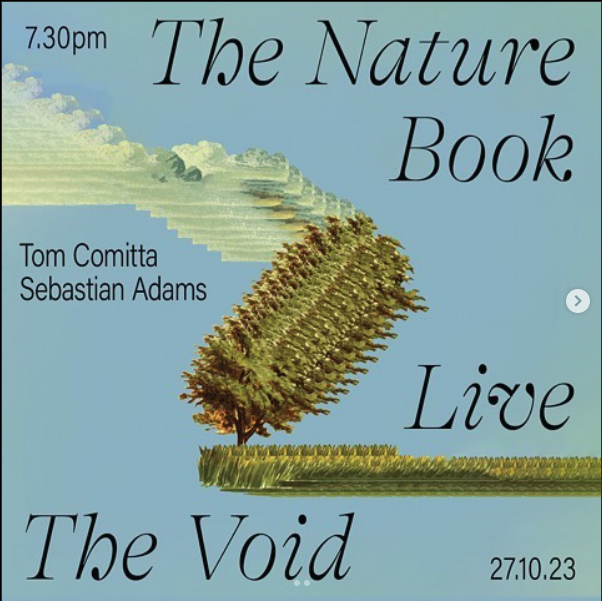
The Nature Book performance with Tom Comitta (Unit 44)
(2023)
improvised electronics performance (radios, samples) combined with readings by Tom Comitta from The Nature Book (Unit 44)
The Nature Book performance with Tom Comitta (Unit 44)
(2023)improvised electronics performance (radios, samples) combined with readings by Tom Comitta from The Nature Book (Unit 44)
Circum (after James Joyce)
(2022)
[8]
any instruments, performing from a projected animated score (originally: accordion, flute, percussion, soprano)
Circum (after James Joyce)
(2022) [8]any instruments, performing from a projected animated score (originally: accordion, flute, percussion, soprano)
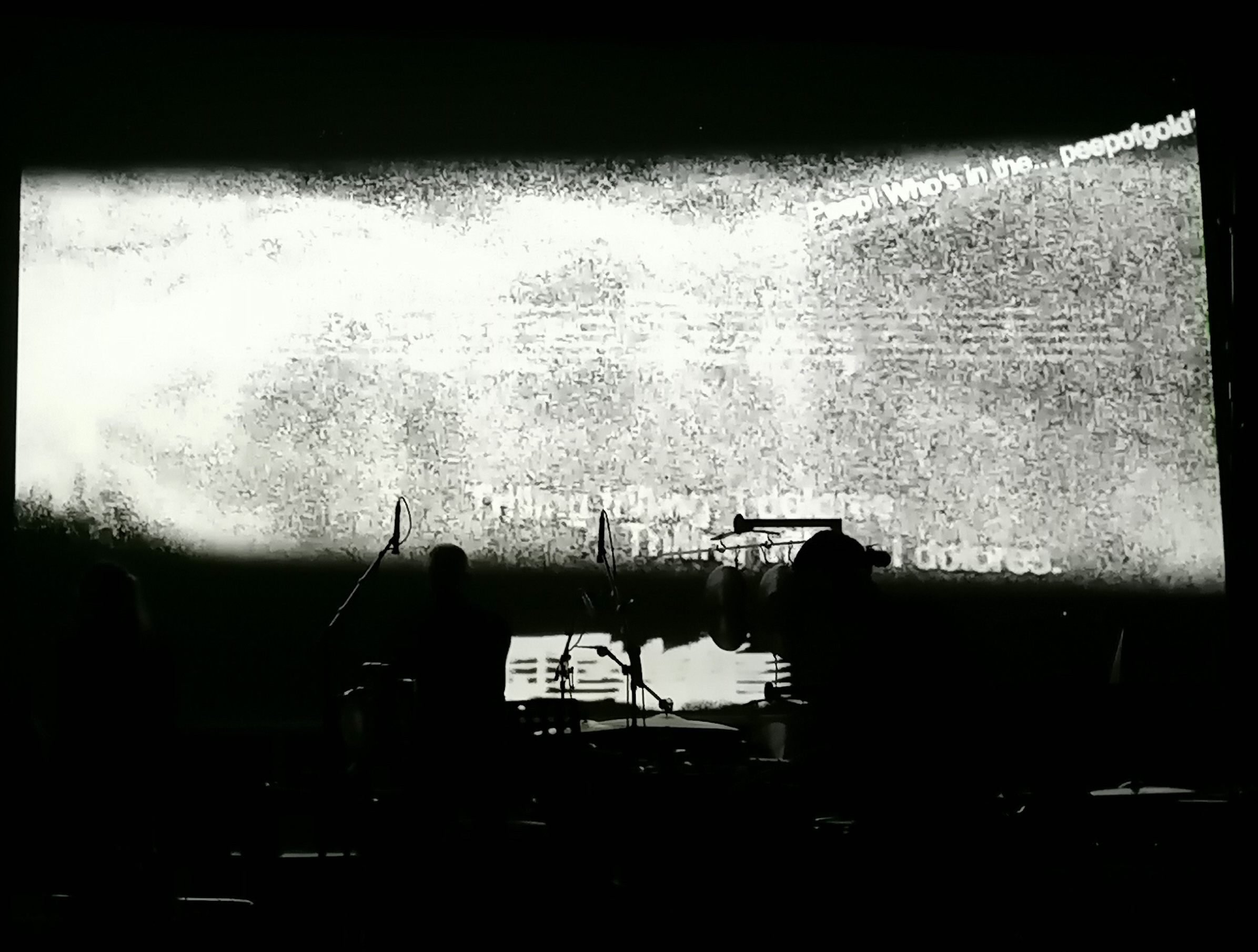
Circum is an experiment in creating a silent, animated score: the visual element is supposed to be visible both to the performers and the audience and it acts as the entire "text" for the performers. For the musicians, the video inspires them to create sound, generating a feedback loop where their actions are affected both by the video and the sonic choices they have already made. For the audience, however, sound and sight unfold simultaneously. Circum is also my first attempt as an Irish artist to get into the world of James Joyce - probably the most important Irish artist? My transitions, which sit between pieces focused on specific episodes of Ulysses, transverse the entire text (backwards) in several ways, treating Bloomsday like Groundhog Day. The animated score is made of text transformed algorithmically into music notation, both displayed using particle systems
Commissioned by: Between Feathers
[all] [chamber] [electronic] [instrumenty] [video]
sunday morning hawk cliff
(2011)
[4]
fixed media stereo audio
sunday morning hawk cliff
(2011) [4]fixed media stereo audio
Hawk Cliff (also known as the Vico Baths) is probably the most beautiful and peaceful place to swim in Dublin (unless the water is too rough or there are jellyfish around..). I was given an assignment to combine field recordings with home-made synthesiser sounds, and decided to use the sea as a soundtrack. I decided to use my music to complement the soundtrack, rather than the other way around, so my contribution is quite minimal! Thanks to Mark Horgan, for moral support and judicious help with choosing a spot to record from. (Boring technical programme note below)
Nestled beneath Vico Road, where the rich and famous of Dublin lock themselves away from the public, Hawk Cliff is a place of splendid isolation. Men go there, not only to bathe, but to lose themselves to solitude, lulled into meditation by the lapping of the ocean.
To accompany the sound of Hawk Cliff without interrupting its natural rhythm meant stripping back my approach to composition virtually to nothing. There are five different synthesisers, all very simple. Each has three oscillators phased and tuned differently and, at most, a comb filter or ring modulator to add interest to the sound. The pitches used by each synthesiser expand outwards in a kind of Christmas tree formation, with each moving by a different interval. Essentially, each synthesiser builds a chord of a specific stacked interval. They each add pitches at different rates, albeit all too slowly for a discernable beat to come through. Each synthesiser begins its chord from a different note, working by a descending circle of fourths (C,G,D,A,E...). An external ring modulator working equally on all five synthesisers is the only further processing.
By applying a somewhat serial approach to the composition, I reduce the impression my own musical personality leaves on the piece. I thought this was the right way to create a work about somewhere where people go to leave their individuality behind. Rather than becoming lost in thought, the patrons of Hawk Cliff become temporarily lost from thought, and simply exist.
dancing_at_lughnasa_draft2_070725_153
(2025)
[2]
fixed media stereo audio
dancing_at_lughnasa_draft2_070725_153
(2025) [2]fixed media stereo audio
made at the request of Dan Callanan for Department of Energy's Ambient Harvest (Landscape Mixtape). Track 25 on the mixtape
Made from Bill Whelan's soundtrack from Dancing at Lughnasa using MuBu for audio-descriptor-based concatenative audio synthesis.
Stolen Music
(2022)
[10]
fixed-media multi-channel video, diffused stereo sound, printed text materials, audience members with kazoos, interactive website and live narration
Stolen Music
(2022) [10]fixed-media multi-channel video, diffused stereo sound, printed text materials, audience members with kazoos, interactive website and live narration
Stolen Music was originally conceived for my final project as part of the IRCAM Cursus, but it is also an ongoing musical world-building project composed of websites, audio collages, acts of piracy etc.
The basic aim of the project is to explore two main ideas that matter to me:
Examining the boundaries of a "piece" of music: questioning the idea of the sole author and finding ways to subvert the linear, sectional timeline of a typical musical performance
Presenting an argument that all musical material should be fair game for all people to work with, regardless of who owns it under current copyright law.
This project owes a huge debt to Claudia Jane Scroccaro, the other teachers at IRCAM, and my colleagues from my course who let me mess with their music. Much more info is available on the dedicated website.
Freed Sounds Instrument
(2022)
audience with internet-connected mobile phones
Freed Sounds Instrument
(2022)audience with internet-connected mobile phones
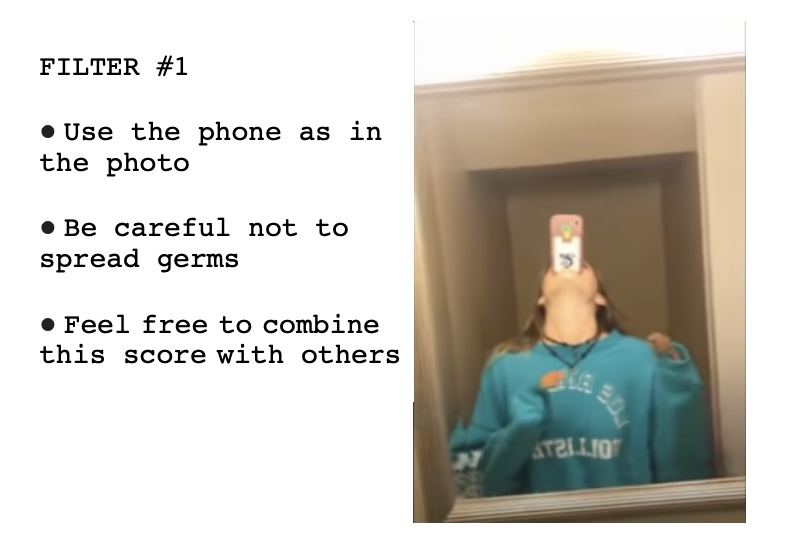
An instrument for playing with samples from freesound.org, with a set of accompanying text scores that can be used to process your performance of this. Suitable for performance in a group using mobile phones as loudspeakers.
Chat Music (collab. with Carl Ludwig Hübsch) [WIP]
(2022)
any instruments, Twitch stream, audience
Chat Music (collab. with Carl Ludwig Hübsch) [WIP]
(2022)any instruments, Twitch stream, audience
trombone, transducer, tam-tam
(2021)
[5]
trombone, percussion (1 player; tam tam, hand-held transducer with small amplifier)
trombone, transducer, tam-tam
(2021) [5]trombone, percussion (1 player; tam tam, hand-held transducer with small amplifier)
How to Build a VIOLIN in TWENTY MINUTES Tutorial
(2021)
[20]
open instrumentation, designed for audience performance
How to Build a VIOLIN in TWENTY MINUTES Tutorial
(2021) [20]open instrumentation, designed for audience performance
Small adjustments that over the years forged a new landscape [collab. Joan Somers Donnelly]
(2019)
[120]
performance installation; viola/performer/electronics/vegetation/casette players/
Small adjustments that over the years forged a new landscape [collab. Joan Somers Donnelly]
(2019) [120]performance installation; viola/performer/electronics/vegetation/casette players/
Umbrella [collab. with Jools Gilson; early prototype]
(2019)
installation for electronic umbrella and audio [presented at CARPA6, Helsinki, Aug 2019]
Umbrella [collab. with Jools Gilson; early prototype]
(2019)installation for electronic umbrella and audio [presented at CARPA6, Helsinki, Aug 2019]
Dankgesang II: Trump
(2019)
[7]
tape
Dankgesang II: Trump
(2019) [7]tape
2019.6
(2019)
[7]
horn, electronics
2019.6
(2019) [7]horn, electronics
Omegle Piece
(2019)
event score
Omegle Piece
(2019)event score
[VIEW TEXT SCORE]
2019.1
(2019)
double bass, transducer, optional electronic processing
2019.1
(2019)double bass, transducer, optional electronic processing
Dankgesang I
(2019)
[9]
any instrument(s), tape
Dankgesang I
(2019) [9]any instrument(s), tape
Deciphering
(2018)
generative notation system, seven performers
Deciphering
(2018)generative notation system, seven performers
Stories from the Rain Box [collab. With Jools Gilson]
(2017)
[28]
radio documentary; sound art
Stories from the Rain Box [collab. With Jools Gilson]
(2017) [28]radio documentary; sound art
Harry Patch
(2015)
[60]
flute, horn, cello, piano, tape
Harry Patch
(2015) [60]flute, horn, cello, piano, tape
One
(2013)
[20]
viola, live electronics
One
(2013) [20]viola, live electronics
Tweet Piece (#2)
(2012)
[8]
guitar, fixed media electronics
Tweet Piece (#2)
(2012) [8]guitar, fixed media electronics
piece for guitar and tape. Tape part is layered guitar + a pre-recorded voice part composed of tweets and public Facebook posts taken without permission c. 2012. Read by Andrew Donovan
note from then below:
Tweet Piece (#2) was written in response to a request from Anna Murray to write a piece for guitar and tape to help her fill a concert from her newly formed Fractal group.
I had initially declined her request as I was not particularly interested in writing for guitar and tape, but when she came back to me a couple of months later the project suddenly grabbed my attention.
The key motivation behind this piece is an attempt to comment on the nature of privacy in our socially networked twenty-first century world. The spoken word element of the piece is composed entirely from statuses posted publicly (ie available to anyone, and not just their friends) on Facebook and Twitter. This information has all been put into the public domain with the consent of the creator: The fact that I took it without their knowledge and that many of them would doubtless be offended if they realised is exactly the point I am trying to make. Countless people, myself included, are putting out this information without any thought for what might happen to it, and what kind of moral-free reprobate might get their hands on it. The spoken word track was spoken brilliantly by Andrew Donovan, in just two takes.
One of the things I paid great attention to while writing this piece was applying the structure of the music to the text of the spoken word track, and vice versa. I will explain the musical structure first.
This piece is in an arch-shaped sonata form (with a palindromic central section and a three key exposition), and also uses my chopped process system (pioneered in my Work for Harpsichord). The chopped process system works whereby motifs are developed according to a process outside the piece, and then snippets of this process are pasted in to the piece, achieving the logical-sounding aural effect of algorithmic composition, with the bonus of only being able to use the bits that sound good.
The palindromic section of the piece is at the harmonic far-off point, and its palindromic nature mirrors the arch shape of the music around it. The chopped processes (one for each of the eight basic motifs used in the piece) are arch-shaped as well: Each one heads for a far-off point and then back towards its origin. The reason this is important will become clear when I explain the organisation of text.
Sonata Form in Tweet Piece (#2): (NB: this doesn't work without word's formatting but whatever)
Three Key Exposition Development Recapitulation CODA
E C (B#) B B> F# A G G# Bb C F D# C# D C >B E E
first second third 1 3 1 3 2 1 3 2 1 2 3 1[312 ()2] 1 3 2 1 3 2 1 2 1 1 3 2 3 3 1 2 1 1 2 3 layers
motivic group FOP
At C, the chopped processes, as well as the sonata form, have reached their far-off point (ie the motifs are as far away from the original ‘tonic’ versions of the motifs as they can get). At this point, we enter the palindromic cadenza, which is based on freely developed material not related to the basic motifs (the only passage of free material in the piece). This cadenza is heard over a particularly insane and lengthy facebook status which I really enjoy...
The harmonic movement of the piece can be easily followed by the ‘bassline’ a simple subtractive gesture which is announced by the guitar in bar one and heard in the tape part throughout the piece except for underneath the cadenza. This bassline (which also follows a chopped process) changes key very crudely at each point of modulation.
And now to the ‘tweets’: I thought it essential that the spoken word content was in some way closely linked to the musical content. To do this I needed it to somehow develop throughout the piece, and then to gradually work its way home. The solution I came up with was to divide the statuses I had harvested from Facebook and Twitter into three groups by subject matter. I gave each group two extremes of theme, and then ordered each snippet on a scale between these two extremes, creating gradual progression from one to the other.
I now had three subject groups of spoken material to go alongside the three groups of motivic material. The next step was the important one: Each motivic group could only be used when its corresponding spoken word group was present in the track. To make it more obvious what I mean, here are the three groups: First motivic group (tonic: Self-obsessed observations, FOP: Funny observations), second motivic group (tonic: Sad statuses, FOP: angry statuses), third motivic group (tonic: Subtle advertising in facebook posts, FOP: Overt advertising).
As will hopefully be clear from the above, what I ended up with was a piece where both the spoken word element and the musical material would begin in a tonic (key/mood/basic presentation of motif), move gradually towards the central far off point and then reverse and move on a different trajectory back towards home, eventually coming full circle.
One other important consideration was that the only way I could compose this piece was by waiting until I had recorded the spoken word track before actually writing the guitar part, as only then would I know how long I needed for each motif. In this way, also, the guitar and spoken word are inextricably linked.
Sebastian Adams, May 2013
Lightbulb [audio only, visuals by Mary Leonard]
(2012)
[4]
fixed media electronics and video
Lightbulb [audio only, visuals by Mary Leonard]
(2012) [4]fixed media electronics and video
sunday morning, hawk cliff
(2011)
[5]
fixed media electronics
sunday morning, hawk cliff
(2011) [5]fixed media electronics
Rhythm Study No. 2
(2011)
[5]
MIDI Piano
Rhythm Study No. 2
(2011) [5]MIDI Piano
Evinescence
(2011)
[6]
accordion, fixed media electronics
Evinescence
(2011) [6]accordion, fixed media electronics
Underwater World
(2010)
[7]
fixed media electronics
Underwater World
(2010) [7]fixed media electronics
Mirrors and Reflections
(2010)
[5]
viola, fixed media electronics
Mirrors and Reflections
(2010) [5]viola, fixed media electronics