I’m a musician from Dublin, Ireland. I also do contract work as a computer music designer. Download and use anything you want from this site. Feel free to get in touch with questions! I also have A NEW BLOG!
Singing Hollow
(2025)
[240]
A performance installation for church bells (method ringers), organ, and walking instruments. Designed around St Audoen's Church, Dublin but adaptable to new spaces. Two computers required.
Singing Hollow
(2025) [240]A performance installation for church bells (method ringers), organ, and walking instruments. Designed around St Audoen's Church, Dublin but adaptable to new spaces. Two computers required.
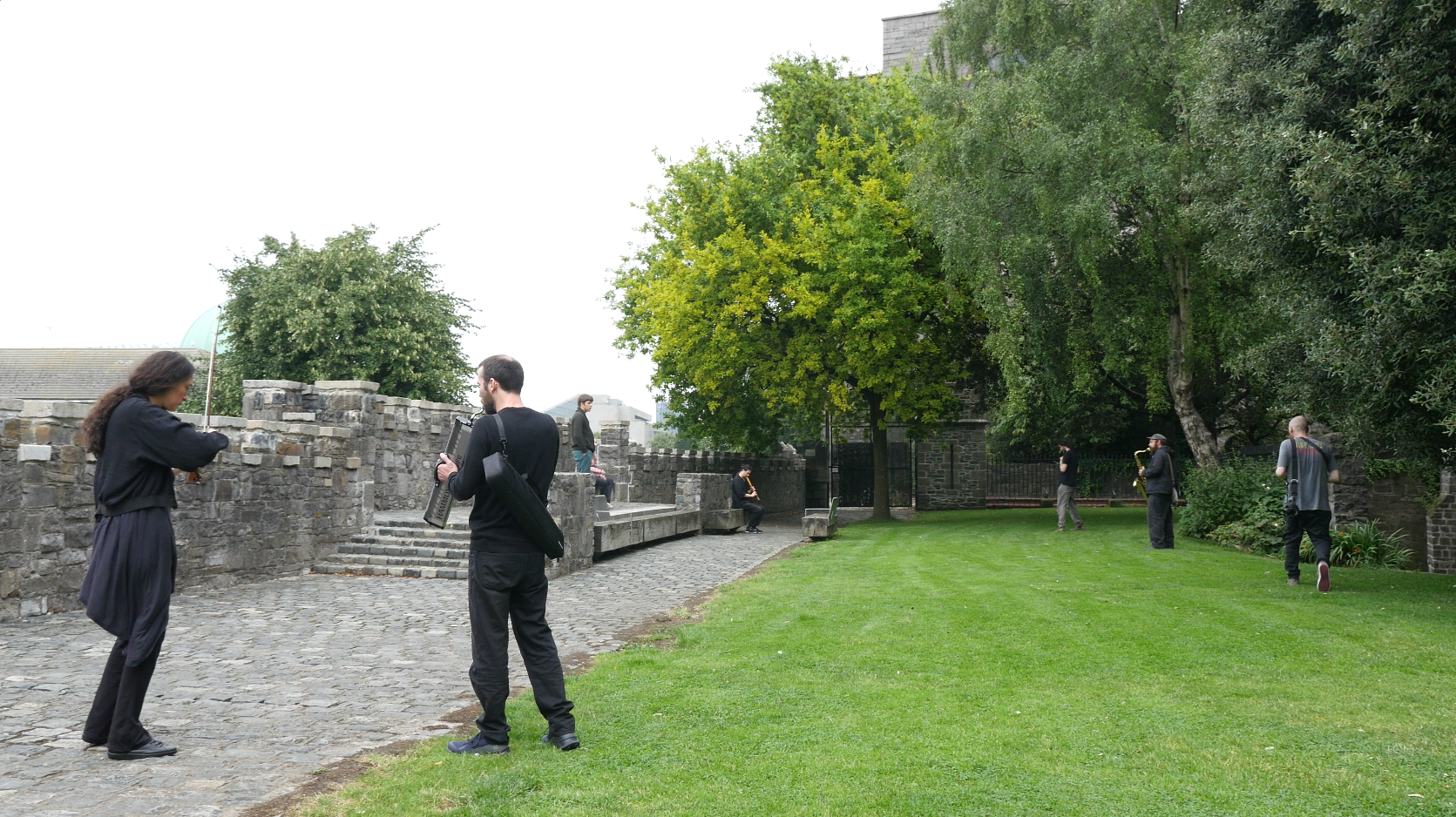
The linked website includes documentation, a web-based score and much more detailed information about the piece.
The Singing Hollow sculpture in St Audoen's Park invites visitors to put their heads into a hole inside a rock. It creates an acoustic transformation reminiscent of the feeling of sanctuary from the outside world that comes when you walk into a church. This inspired this live sound installation: organ plays inside the church, musicians play in the grounds, and church bells bridge both worlds, all playing parts that are both independent and interdependent.
In the original performance, the piece is designed for four outdoor instruments, six church bells (each one rung by an individual) and an organ. It was specifically written for St Audoen’s Church of Ireland, which is an incredibly old church.
Commissioned by: The Office of Public Works and The Liberties Festival
[all] [chamber] [generative] [installation] [software] [improvisation] [gig] [web] [fluxusy]
Traffic Piece
(2025)
[840]
durational installation (14 hours) for multiple groups of instruments, video, audio and live traffic; devoted to Unit 44!
Traffic Piece
(2025) [840]durational installation (14 hours) for multiple groups of instruments, video, audio and live traffic; devoted to Unit 44!
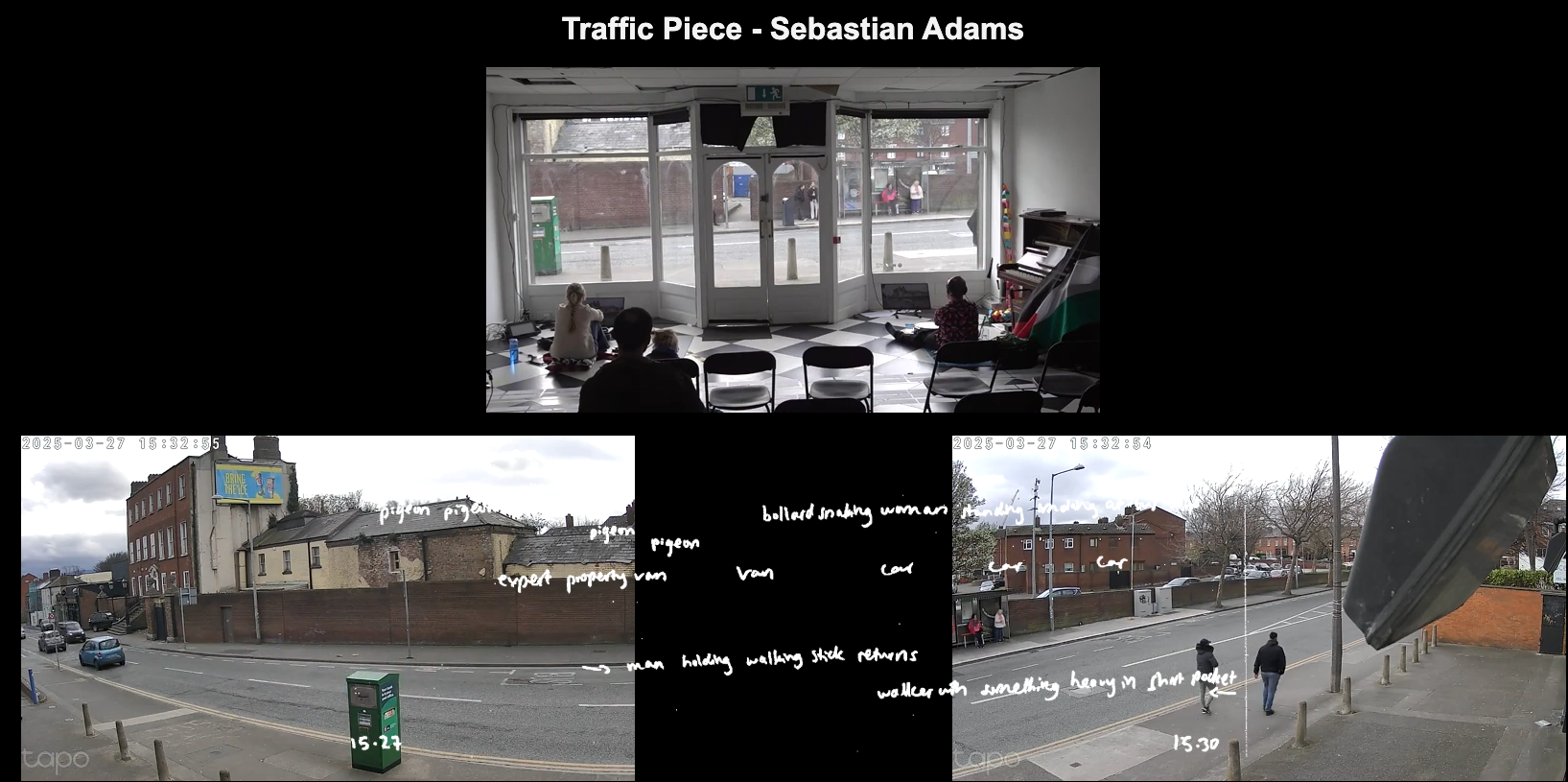
Presented here in a web installation version that locks the viewer to the specific moment from the performance corresponding to the current time of day.
Traffic Piece was created as a goodbye to Unit 44, a venue Kirkos ran which was heavily impacted by traffic sound. It ran from rush hour in the morning to rush hour at night. I got the idea for this piece during a beautiful saxophone performance by Josten Myburgh where his barely audible multiphonics fought for attention with the traffic outside in a way that really captivated me. After four years watching the traffic pass Unit 44, I thought sitting down and really listening to it would be the perfect way to say goodbye to the venue.
A bunch of the performers who contributed a lot to Unit 44 played a 14-hour long score (working in shifts) made from a full week of security cam footage of the street outside Unit 44, while they and the audience also watched the traffic in real life.
These different time cycles (moment to moment, rush hour to rush hour, Monday to Sunday) will mingle with pitch material derived from the resonances of Unit 44 itself to influence a ritualistic performance which is fully about the specific place that Unit 44 is and has been, and about the way the outside world has spilled into it.
The piece finished with a guided improvisation using the traffic as a score, open to all.
06:30 - 08:10 Shift 1: Sebastian Adams and Tom Roseingrave
08:10 - 8:30: traffic only
08:30 - 10:10: Shift 2: David Bremner and Sharon Phelan
10:10 - 10:30: traffic only
10:30 - 12:30: Shift 3: Aonghus McEvoy, Susan Geaney, David Lacey, Nick Roth
12:10 - 12:30: traffic only
12:30 - 14:10: Beethoven Freeze: Sebastian Adams and Robert Coleman
14.10 - 14.30: traffic only
14:30 - 16:10: Shift 5: Kevin Free and Jane Hackett
16:10 - 16:30: traffic only
16:30 - 18:00: in nomine: Sebastian Adams, Hannah Miller, Caitríona O'Mahony
18:00 - 18:30: traffic only
18:30 until the traffic ceases: Shift 7: open improv jam (all welcome)
Joan Somers Donnelly made a parallel performance taking notes on the passing traffic almost all day
Beginner's Guide to Slow Travel (co-composed by Kirkos)
(2023)
[60]
concert piece with slow travel, devised by Kirkos (horn, violin, cello, viola, melodica, chairs)
Beginner's Guide to Slow Travel (co-composed by Kirkos)
(2023) [60]concert piece with slow travel, devised by Kirkos (horn, violin, cello, viola, melodica, chairs)
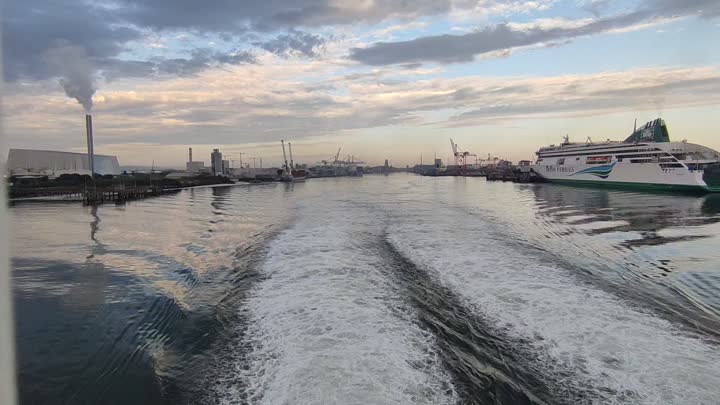
Beginner’s Guide To Slow Travel is a devised piece composed collaboratively by Sebastian Adams (1991), Robert Coleman (1989), Yseult Cooper Stockdale (1991), Jane Hackett (1991), Hannah Miller (1994) and Joan Somers Donnelly (1991).
How can we craft new ways to navigate the world as the tangible impact of anthropogenic climate change accelerates? One of the huge challenges for music will be adapting to a world where air travel no longer seems justifiable. Dublin-based new music group Kirkos have taken the logistics of their slow travel to Huddersfield, with the extra time, expense and change of internal rhythm it necessitates, as a starting point for this new devised piece. From there, the adventurous experimentalists leap into a sonic and spatial exploration of collecting and reusing, rest, energy transfer, interspecies entanglement and collective grief.
Additional elements of this piece, including artistic documentation of the journey to the festival, will gradually become available at www.kirkosensemble.com/beginners-guide in the lead-up to the festival.
Commissioned by: Commissioned by New Music Dublin, Huddersfield Contemporary Music Festival and Sound Scotland; supported by Culture Ireland and PRS Foundation Beyond Borders
[all] [chamber] [improvisation] [collaboration] [fluxusy]
Excerpts from Reality
(2025)
[-]
video score for open instrumentation (premiere: flute, clarinet, violin, cello, electric guitar)
Excerpts from Reality
(2025) [-]video score for open instrumentation (premiere: flute, clarinet, violin, cello, electric guitar)
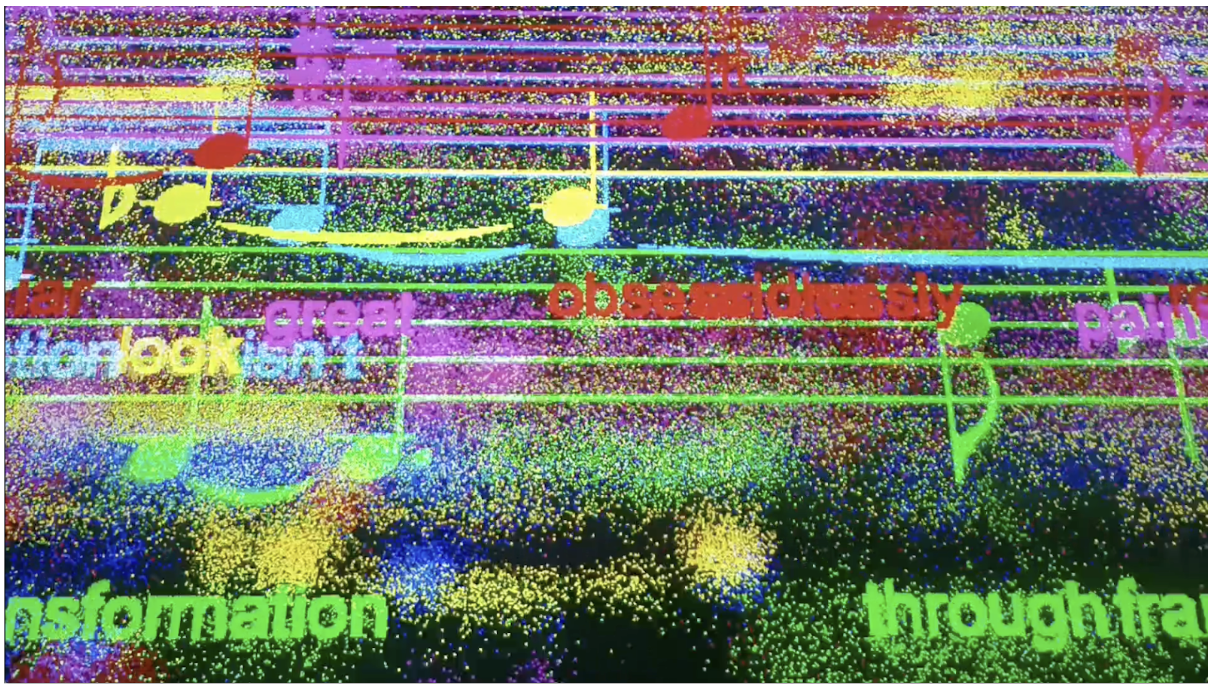
Excerpts from Reality was written for a Crash Ensemble performance held in UCD, and draws on text from Reality Hunger, a text which is itself made from found text (hence the piece ties in to Stolen Music). In my piece, text drawn from the book is depicted on a video screen as clouds of particles arranged into the text which dissolve gradually and rearrange as music notation (which is algorithmically derived from the text). The video screen serves as a score for the performers, who are expected to interpret the overall visual and semiotic impression (notation, text, colours, movement) and use it as a source for improvisation. As the score is also improvised (by the composer, using an interface which allows selection of specific passages of text as well as control of various visual parameters and the algorithm used for translating into notation), a complex feedback loop between composer, performers and video arises: agency becomes distributed across the performers and composer in a way which is difficult to unravel. As such, it is an attempt to place the composer in the midst of performers as a fellow improviser.
Fluxkit Transcriptions
(2024)
open instrumentation, including typist (premiere: flute, horn, keyboard, cello, typist)
Fluxkit Transcriptions
(2024)open instrumentation, including typist (premiere: flute, horn, keyboard, cello, typist)
A typist transcribes texts contained in a Fluxkit into musical notation, which is displayed to performers (and audience). The music notation, along with the typed text, is then used as a framework for improvising by a group of performers.
To play this piece, you also need to get or make a Fluxkit. A Fluxkit is a collection of event scores stored in a container (e.g. Water Yam by George Brecht). I made the piece with the Fluxkits Kirkos created in 2016 in mind, and used one of these to play the premiere. If you don’t have access to a Fluxkit, you could make one, for example by cutting up parts of the Fluxus Workbook (freely available online e.g. on the Monoskop website) and placing them in a box.
The first performance of this piece was played by Lina Andonovska, Hannah Miller, Adam Collins and Yseult Cooper Stockdale (as Kirkos) on 25.06.24 as part of an Irish Composers’ Collective concert in Unit 44, Dublin. I was the typist for the performance.
The software used for this performance (ChatMusic) is currently only available by request. Please get in touch if you're interested.
Circum (after James Joyce)
(2022)
[8]
any instruments, performing from a projected animated score (originally: accordion, flute, percussion, soprano)
Circum (after James Joyce)
(2022) [8]any instruments, performing from a projected animated score (originally: accordion, flute, percussion, soprano)
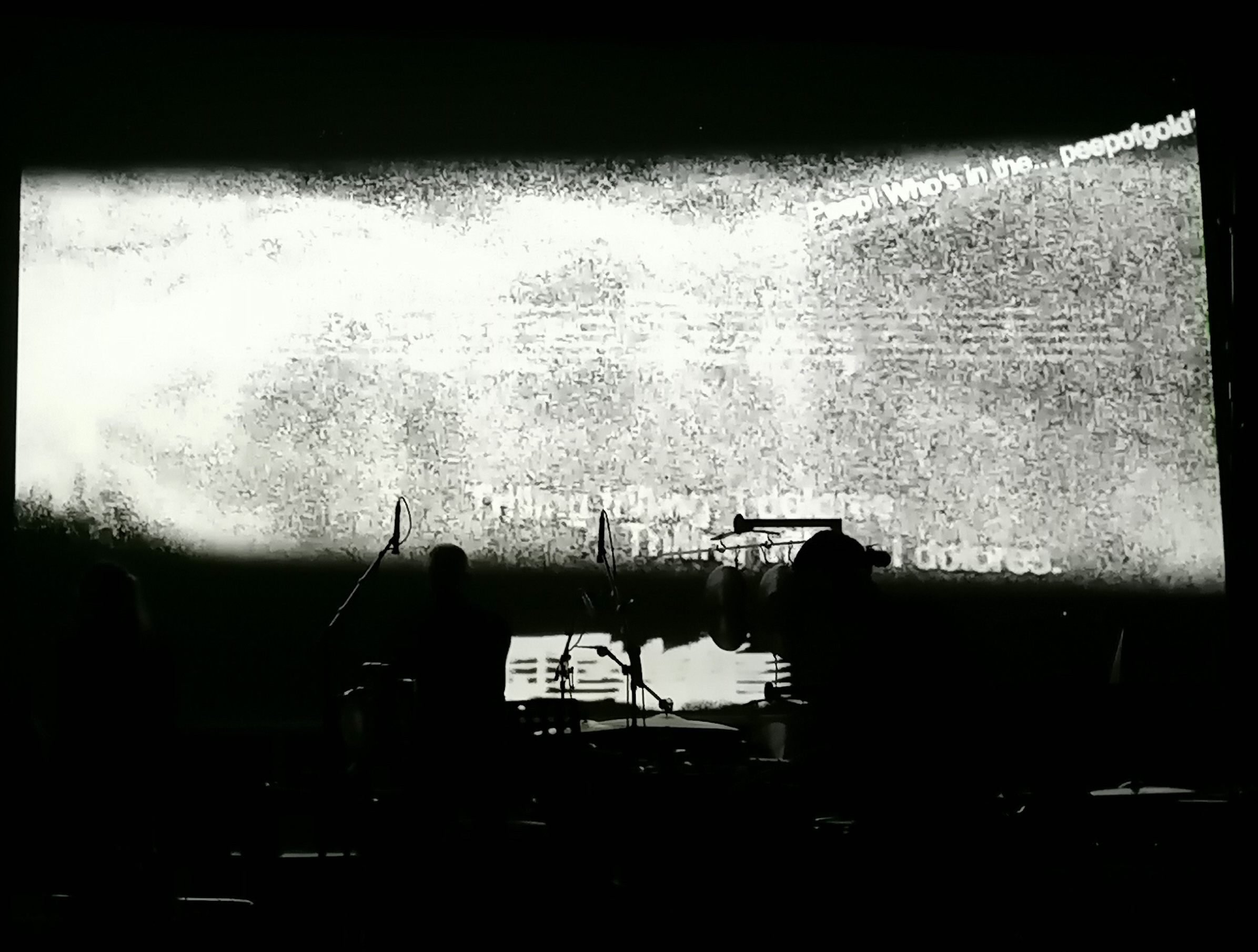
Circum is an experiment in creating a silent, animated score: the visual element is supposed to be visible both to the performers and the audience and it acts as the entire "text" for the performers. For the musicians, the video inspires them to create sound, generating a feedback loop where their actions are affected both by the video and the sonic choices they have already made. For the audience, however, sound and sight unfold simultaneously. Circum is also my first attempt as an Irish artist to get into the world of James Joyce - probably the most important Irish artist? My transitions, which sit between pieces focused on specific episodes of Ulysses, transverse the entire text (backwards) in several ways, treating Bloomsday like Groundhog Day. The animated score is made of text transformed algorithmically into music notation, both displayed using particle systems
Commissioned by: Between Feathers
[all] [chamber] [electronic] [instrumenty] [video]
Freed Sounds Instrument
(2022)
audience with internet-connected mobile phones
Freed Sounds Instrument
(2022)audience with internet-connected mobile phones
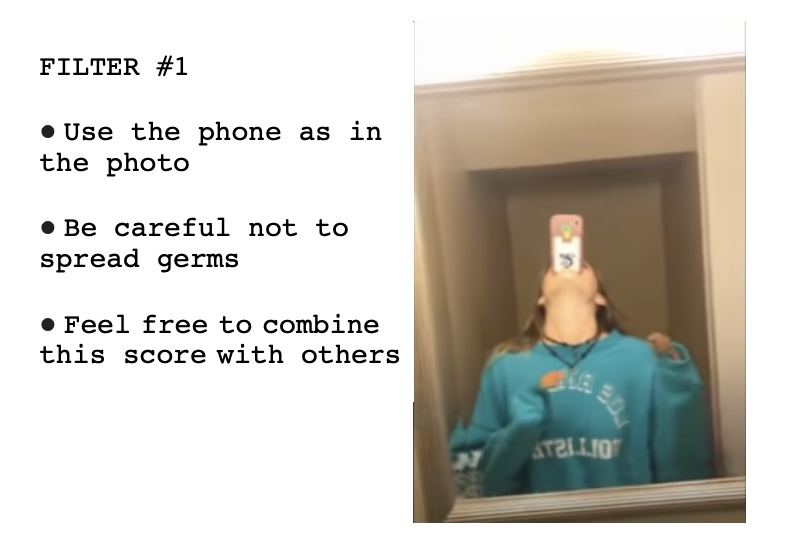
An instrument for playing with samples from freesound.org, with a set of accompanying text scores that can be used to process your performance of this. Suitable for performance in a group using mobile phones as loudspeakers.
Chat Music (collab. with Carl Ludwig Hübsch) [WIP]
(2022)
any instruments, Twitch stream, audience
Chat Music (collab. with Carl Ludwig Hübsch) [WIP]
(2022)any instruments, Twitch stream, audience
Ceiliúradh [part 1] {alternate title: 2022.1}
(2022)
[9]
piano trio (violin, 'cello, piano)
Ceiliúradh [part 1] {alternate title: 2022.1}
(2022) [9]piano trio (violin, 'cello, piano)
trombone, transducer, tam-tam
(2021)
[5]
trombone, percussion (1 player; tam tam, hand-held transducer with small amplifier)
trombone, transducer, tam-tam
(2021) [5]trombone, percussion (1 player; tam tam, hand-held transducer with small amplifier)
How to Build a VIOLIN in TWENTY MINUTES Tutorial
(2021)
[20]
open instrumentation, designed for audience performance
How to Build a VIOLIN in TWENTY MINUTES Tutorial
(2021) [20]open instrumentation, designed for audience performance
Tide Quartet
(2020)
[90]
string quartet; violin, violin, viola, cello
Tide Quartet
(2020) [90]string quartet; violin, violin, viola, cello
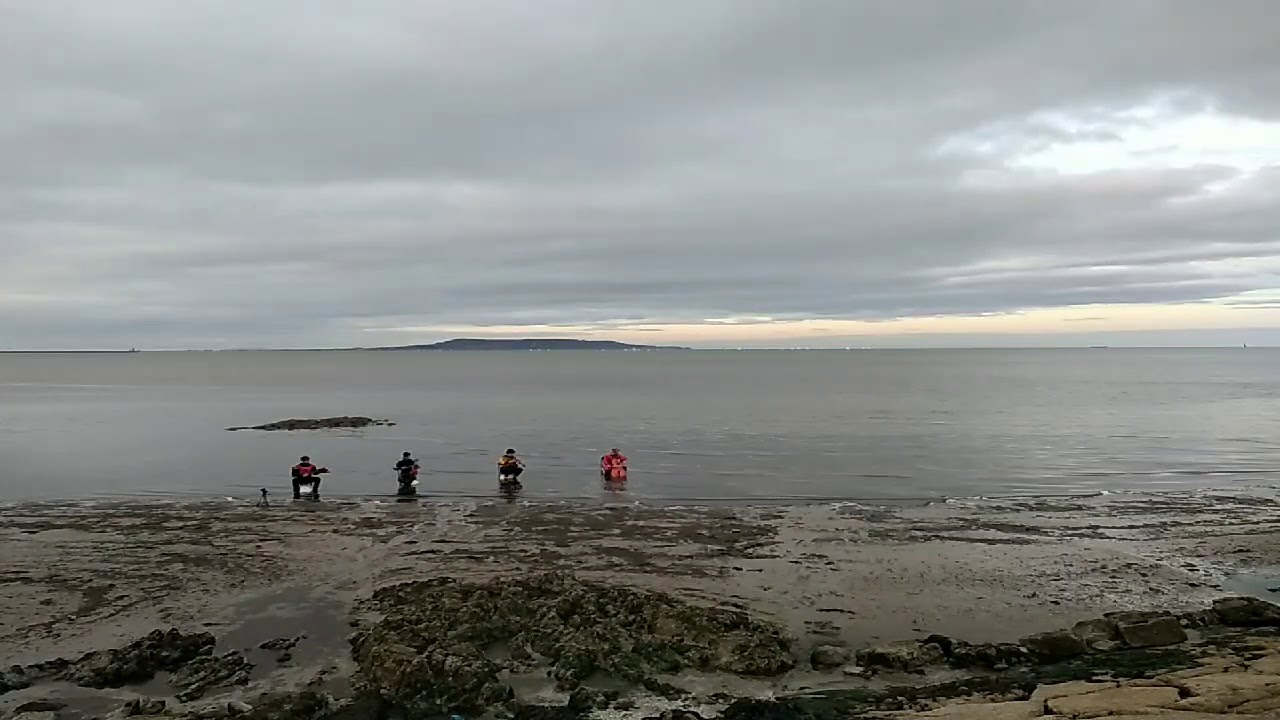
A string quartet dress in wet suits, sitting on chairs on the dry sea-bed in Dublin Bay. They perform a theme and variations (improvised from a set of instructions) as the tide begins to rush in around them. The performance ends for each musician only when the water reaches their neck, making it a durational piece reliant on the speed of the tide. Afterwards, the saturated instruments will be retrieved and the composer will attempt to save them by leaving them to dry naturally. This process will also be recorded and shown on this website. Unsalvageable parts will be repaired using driftwood, and the piece will be performed again next year.
2019.8
(2019)
string quartet; violin, violin, viola, cello
2019.8
(2019)string quartet; violin, violin, viola, cello
short quartet with improvised response
(2019)
[8]
string quartet; violin, violin, viola, cello
short quartet with improvised response
(2019) [8]string quartet; violin, violin, viola, cello
Omegle Piece
(2019)
event score
Omegle Piece
(2019)event score
[VIEW TEXT SCORE]
Dankgesang I
(2019)
[9]
any instrument(s), tape
Dankgesang I
(2019) [9]any instrument(s), tape
Weight Piece
(2018)
event score
Weight Piece
(2018)event score
[VIEW TEXT SCORE]
2018.5
(2018)
[6]
bassoon, cymbal [bassoon part works on low wind generally - contrabass clarinet, baritone saxophone, trombone etc.]
2018.5
(2018) [6]bassoon, cymbal [bassoon part works on low wind generally - contrabass clarinet, baritone saxophone, trombone etc.]
2018.4_c
(2018)
any instruments (first played by viol consort)
2018.4_c
(2018)any instruments (first played by viol consort)
2018.4_b
(2018)
any instruments (first played by viol consort)
2018.4_b
(2018)any instruments (first played by viol consort)
2018.4: in nomine
(2018)
[5]
four instruments or string quartet
2018.4: in nomine
(2018) [5]four instruments or string quartet
2018.3
(2018)
[6]
violin, cello
2018.3
(2018) [6]violin, cello
2018.1
(2018)
[20]
piano trio; violin, cello, piano
2018.1
(2018) [20]piano trio; violin, cello, piano
Deciphering
(2018)
generative notation system, seven performers
Deciphering
(2018)generative notation system, seven performers
2017.4
(2017)
[12]
horn quartet; 4 Horns in F
2017.4
(2017) [12]horn quartet; 4 Horns in F
The Mother
(2017)
[4]
soprano, piano
The Mother
(2017) [4]soprano, piano
2016.3
(2016)
[7]
string quartet; violin, violin, viola, cello
2016.3
(2016) [7]string quartet; violin, violin, viola, cello
String Quartet No. 2
(2016)
[15]
string quartet; violin, violin, viola, cello
String Quartet No. 2
(2016) [15]string quartet; violin, violin, viola, cello
2015.4b
(2015)
[5]
flute, clarinet
2015.4b
(2015) [5]flute, clarinet
2015.4
(2015)
[5]
treble recorder, clarinet in Bb
2015.4
(2015) [5]treble recorder, clarinet in Bb
Harry Patch
(2015)
[60]
flute, horn, cello, piano, tape
Harry Patch
(2015) [60]flute, horn, cello, piano, tape
2015.2
(2015)
[9]
string quartet; violin, violin, viola, cello
2015.2
(2015) [9]string quartet; violin, violin, viola, cello
Workings from Work for Harpsichord
(2014)
generative notation system, three performers
Workings from Work for Harpsichord
(2014)generative notation system, three performers
2013.8
(2013)
[13]
piano trio; violin, cello, piano
2013.8
(2013) [13]piano trio; violin, cello, piano
CrowdScoreSing
(2013)
[8]
violin, cello, flute, horn, trumpet, percussion (glockenspiel, cow, piano, three actors
CrowdScoreSing
(2013) [8]violin, cello, flute, horn, trumpet, percussion (glockenspiel, cow, piano, three actors
CrowdScoreSing is a piece based on suggestions which were
made via Facebook comments over a forty-eight hour period
in early 2013. The concept required that I would incorporate
all practical suggestions into the piece. And I have.
Rite of Spring: Introduction
(2013)
[4]
violin, viola, cello (string trio)
Rite of Spring: Introduction
(2013) [4]violin, viola, cello (string trio)
Song for Hilda
(2013)
[4]
piano, high voice, high voice
Song for Hilda
(2013) [4]piano, high voice, high voice
Work for Quartet
(2012)
[8]
violin, viola, cello, doublebass
Work for Quartet
(2012) [8]violin, viola, cello, doublebass
Work for Piano Trio
(2012)
[8]
piano trio; violin, cello, piano
Work for Piano Trio
(2012) [8]piano trio; violin, cello, piano
Prayer for four hands
(2012)
[10]
piano four hands
Prayer for four hands
(2012) [10]piano four hands
Work for viola, marimba and piano
(2011)
[8]
viola, marimba, piano
Work for viola, marimba and piano
(2011) [8]viola, marimba, piano
Work for Quintet
(2011)
[8]
flute, clarinet, violin, viola, piano
Work for Quintet
(2011) [8]flute, clarinet, violin, viola, piano
Quadrilateral
(2011)
[7]
soprano, saxophone, trumpet, double bass, drum kit
Quadrilateral
(2011) [7]soprano, saxophone, trumpet, double bass, drum kit
Work in Fifths and Thirds
(2011)
[8]
flute, piano
Work in Fifths and Thirds
(2011) [8]flute, piano
Miniature for Cello and Piano
(2011)
[6]
cello, piano
Miniature for Cello and Piano
(2011) [6]cello, piano
Swell
(2011)
[6]
string quartet; violin, violin, viola, cello
Swell
(2011) [6]string quartet; violin, violin, viola, cello
String Quartet No. 1
(2011)
[10]
string quartet; violin, violin, viola, cello
String Quartet No. 1
(2011) [10]string quartet; violin, violin, viola, cello
Kammerskizze
(2011)
[8]
clarinet, violin, cello, electric guitar, accordion
Kammerskizze
(2011) [8]clarinet, violin, cello, electric guitar, accordion