I normally don't do arrangements (not that I get asked to very often), but I made an exception recently to work with Sal Stapleton on their new electronic piece LUNA (somewhere between an opera and a live concept album). The reason I said yes was that I worked as a production manager / engineer on Sal's work with Black Magic Rawr (afro-futurist project with A/V by Sal) and was pretty much blown away by their work. But I did immediately say that I don't really know how to do arranging and I would probably try to make it "quite improvisey". Thankfully, Sal said yes. Part of the reason I felt free to suggest making arrangements designed to be played with freedom was that I knew Sal and producer Renn Miano had scheduled relatively generous rehearsal and workshop periods: this wasn't going to be a project where the band was going to be hanging on by the seats of their pants in the performances1.
The scope of the project was c. 12 songs arranged into the 8 phases of the moon, with another artist working on choir arrangements and my role being to make string arrangements, fix the band and (if I wanted to2) perform in it. Sal's material consisted of fully mixed electronic tracks that often already had sophisticate string arrangements in them. So in many cases, my role initially seemed to be mainly just to transcribe string parts out of the arrangement. Sal doesn't read music and is a fully self-taught musician, so needed help from somebody else in order to make it possible for human players to perform the music (although the parts they had written were idiomatic and needed little adaptation).
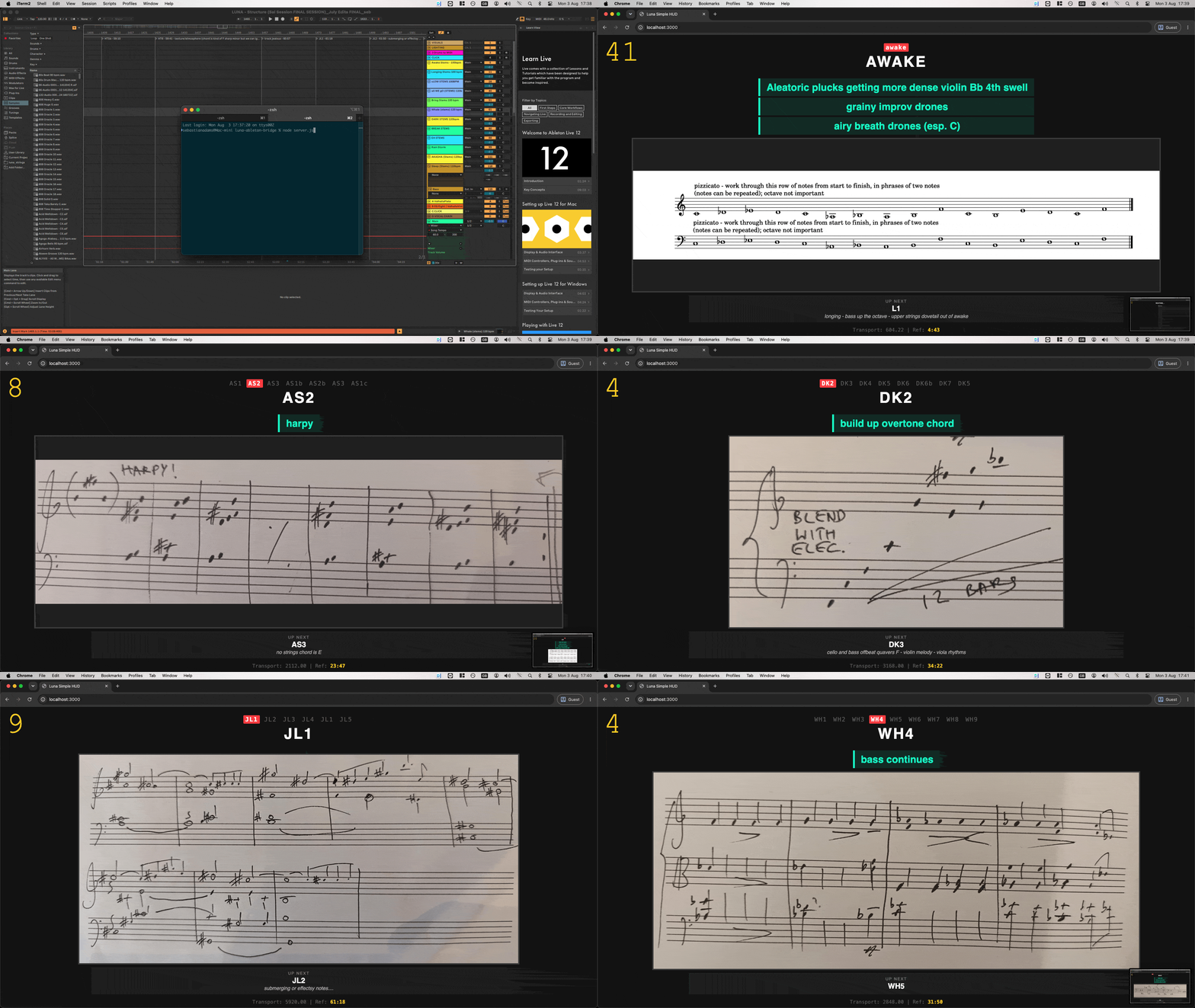
(screengrabs from the software we used in place of traditional sheet music)
ableton-score
The music was mostly loop-based, with songs making use of repeated sections which added and subtracted layers on repetitions, making liberal use of ear-candy. Sal works in Ableton Live and would be performing and manipulating the session in the performance. Because of this, I decided to use a cellular notation system rather than writing linear sheet music.
The system used the Ableton Live API via JavaScript to create a video-game style HUD (heads up display) in the web browser that showed text and/or an image of the current musical cell along with key information like the number of bars remaining in section, position in current song structure, contents of next section etc.
I anticipated that this would have several advantages:
- it would free up mental bandwidth for the string players: they wouldn't need to keep track of their place on the page or count bars3.
- it would bring the musical structure to the surface
- using loose/simple notation would imply and encourage freedom and improvisation: this was a mixture of full notation, shorthand music notation and text only
- As I used a techy solution, it meant we had a "guaranteed4" sync point with Sal's Ableton session
- The locator-based structure system meant that Sal could extend or shorten sections (or even add new repetitions of sections) without me needing to change the string score.
I'm happy to say that the system passed with flying colours and people seemed to find it easy and fun to use. I've made a generalised version of it (without any of Sal's music) available here. Please feel free to try it out and let me know if you have any thoughts on it, or find it useful. I'll probably write a technical writeup of the software at some stage.
Assembling a dream team
The choice of musicians for the string section was extremely important: the gig was a pretty unusual scenario, comfortable neither for a straight-ahead classical musician nor for a musician who does not read music well. I ended up working with musicians I didn't know that well but who came highly recommended by people I trusted5.
I was extremely lucky! At the first workshop, I was feeling very behind: the work was going slowly and I had much less done than I had expected, and was both stressed and apologetic. Minutes in, it became clear that Kate Fleming (the violinist) could play any melody by ear after hearing it once, and that Caitríona Finnegan and Graham Heaney were both game for trying anything out on the spur of the moment. Everybody was willing to make the best of whatever was available (i.e. literally nothing, in many cases).
This ended up shaping how I continued to work, as it meant there were many parts where I could just write shorthand text notation.
Distributed agency - and a music world ill-equipped for it
Being behind with the work also put me in a place where I was very receptive to the ideas of the other musicians, and where they were not intimidated out of making suggestions or trying things out because "a real composer" had already decided what they should be doing. This meant early rehearsals were quite like jam sessions, and my arranging work shifted to being also about notating and developing ideas contributed by Kate, Caitríona and Graham, rather than just working with Sal's source material.

In rehearsal, I was a band leader (I had control over the hallowed space bar). I focused on trying to create an open, fun atmosphere where the other string players felt empowered to try out ideas, make suggestions & embellish things. Often, I would stop a section to say e.g. "Caitríona, that thing you did was great, let me note that down" or "that was a cool new thing, why don't we all do that next time?". I also tried to lead by example by deviating as far as possible from the written music regularly.
This was a very blurred authorship: There is no way a listener would have any idea of where the line is between what Sal wrote (i.e. parts that were direct transcription of the source material by me) and what was arranged or elaborated on by me. They would have less idea still of which parts were contributed by the other string players.
I mentioned this blurred authorship at rehearsal, saying I felt like I'm going to get credit both for work that Sal did (i.e. their beautiful string harmonies that I merely wrote down) and for ideas contributed by the band, but all in the band were very quick to disown their contributions or say they didn't care about getting credit. I think this is reflective of under-examined assumptions about authorship in both classical music (where the composer is a clearly separated and delineated role, and the musician is not considered an author) and in pop/rock/jazz, where session musicians are often expected to contribute musical material without being considered a partial author. The role of an arranger here is an interesting one, being a subordinate creative role yet still seen as having agency, artistry and making an authorial contribution (in contrast to the performer who may also be contributing equally important ideas, especially in a less formal context like this)6.
I requested that credits in the programme and publicity material were amended reflective of the expanded creative role that the musicians have (essentially as co-devisors), but in the end I did not pay attention to the outcome of this: this is probably a place where my duties as fixer needed to evolve a bit beyond the norm, to become an advocate for the writes of my colleagues. There is a similar aspect in contracts (always thinking of the unlikely event where something one of the band contributes becomes a Careless Whisper), but I have to say that the original contracts delivered to us were very fair in this respect.
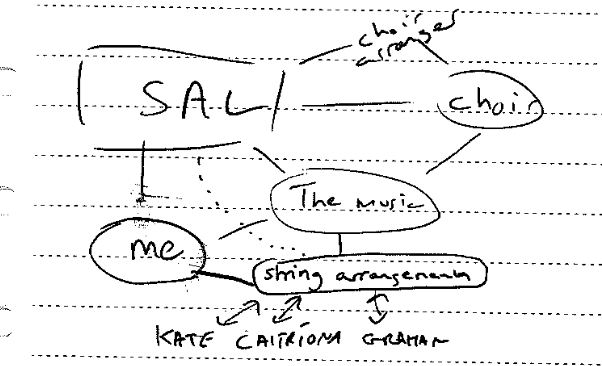
(hierarchy/communication graph - leaving out the production crew, cos I'm CRUEL that way)
The limitations of a score
Loose notation means performance practice developed in rehearsal becomes part of the score. The embodied version of the music - living only in the bodies and minds of the players - is more elaborate and accurate than the notated version, with fills, feel and embellishments added throughout the rehearsal period. The notated version even contains mistakes that did not need to be corrected due to internalisation by the affected players. While it's clear that I should now sit down and correct these mistakes, the question of what to do with the score now in order to ensure reproduction at a later date is possible is much more vexed: we will certainly forget some of what has become embodied, and a newcomer joining the quartet would need much explained to them, but it's possible that more detailed notation would take away some of the immediacy and fun of performing the piece. So, deciding what to notate becomes a question about which aspects of the original performance are most important to preserve: should a version in played three years sound exactly the same, or should it have the same energy, perhaps produced through very different sonic results.
Lost in translation?
An interesting factor when working with a performer from a very different background (e.g. a musician who doesn't read music) is the barriers in communication and vocabulary that come up. The most dangerous of these are the ones where one party doesn't realise there's been a communication, which happens most often when a word is jargon for one kind of musician but also has a use in natural language. These miscommunications can seem like differences of opinion when they actually aren't, and as I gain more experience working with people from different walks of life (because the effect is amplified massively when you work with people who aren't musicians at all7) it's something I try to focus on in rehearsals, especially if I think somebody's opinion seems weird. Between Sal and me it was two personalities who tend towards the accommodating side unless a point is particularly important, so there weren't any moments that caused tension - but there were tines where we were briefly talking at cross-purposes because we are both used to working with different language. I have a feeling that, earlier in my career, I might have barrelled through these occasions assuming that we understood one another.
1This is not so common - as Jennifer Walshe's The New Discipline manifesto says, musicians are used to making it work without the longer rehearsal periods of disciplines like theatre, opera etc.
2 yes
3 If you haven't played orchestral or chamber music, it would probably surprise you how easy it is to get visually lost (when you may not be "musically" in the wrong place) by scanning to the wrong place on a page. This problem is worsened when the music is repetitive or typeset by somebody who is not a professional music engraver (i.e. a composer; nowadays true of almost all notated music).
4 👀
5 thank you Yseult Cooper Stockdale, Joanna Mattrey and Ilona (my sister!)
6 I have to credit Tim Cape with raising my awareness of this: when Tim was developing his piece Smashing the Natural Law for Kirkos, we had a conversation stemming from his concern about the lack of credit given to musicians performing new contemporary classical works where they may often be contributing techniques they have developed as part of their own practice - often doing much of the composer's work for them, as composers tend to get credit for these kinds of innovations - without receiving any kind of authorship: in fact, they are pretty much giving away techniques they have developed to be considered part of somebody else's creative output. Classical performers are trained to accept this as normal.
7 An example that came up with Kirkos was the word "performative": the classical musicians in the group had used performative for years to distinguish a performance that "seems performed", i.e. it has artifice or a clearly intended shape; this is especially relevant with work like Cage or Fluxus where one school of thought would be that the performance should be absolutely "un-performed", meaning whatever is being done should be done as if it was not on stage at all. I think it's commonly used that way in those circles. But to Joan, from a theatre background, the word had a linguistics meaning along the lines of "language that effects change". It was a while before we figured it out, since both meanings made sense in the context it came up in. Every time something like this happens, I go home mortified wondering about all the times I'm involved in a conversation where nobody realises we have been talking at cross purposes (and this doesn't need to involve fancy words, either).
Comments Section
В Москве существует множество автосервисов, специализирующихся на Тойота. В этом автосервисе вы найдете опытных техников, которые знают все о Тойота. Если вам нужен качественный и надежный [url=https://servis-toyota-moskva.ru/remont-toyota-v-moskve/] автосервис Toyota в Москве[/url], мы предлагаем широкий спектр услуг для вашего автомобиля. Работа с автомобилями этой марки требует особого подхода. Мастера сервиса постоянно повышают свою квалификацию для качественного обслуживания. В автосервисе установлено современное оборудование. Это позволяет проводить диагностику и ремонт на высшем уровне. Наш автосервис обеспечивает надежность и долговечность вашего автомобиля. Ваше доверие для нас — наивысшая награда.
Септик — локальная автономная очистная станция для частных малоэтажных домов, которые не подключены к центральной канализации https://water-eco.ru/magazin/product/pegas-oxygen-4 Работает такое оборудование как отстойник: в резервуар (обычно пластиковый) попадают сточные воды, а затем проходят ступенчатую систему очистки и фильтрации https://water-eco.ru/magazin/product/stanciya-evrolos-pro-5-pr После этого воды уходят в грунт, а осадок в септике нужно откачать и заменить фильтры https://water-eco.ru/magazin/product/stancii-biozon-15 Принцип работы и особенности обслуживания могут отличаться в зависимости от вида септика https://water-eco.ru/magazin/product/iskra-l-8 Наиболее распространённые варианты: Отстойники, или переливные септики https://water-eco.ru/magazin/folder/septik-kolovesi/p/1 Представляют собой ёмкость с секторами для ступенчатой очистки https://water-eco.ru/vodopodgotovka-dlya-doma Твёрдые отходы в них перерабатываются бактериями, а жидкость, проходя через фильтр, попадает в грунт или ёмкость для последующей чистки https://water-eco.ru/magazin/product/aeracionnyj-septik-glosen-lett-10s Такие септики нужно периодически очищать, а вода на выходе мутная и имеет запах https://water-eco.ru/magazin/product/septik-kolovesi-10-midi Что учесть при выборе Помимо этого, установка и обслуживание септика обойдутся дороже, чем организация выгребной ямы или подключение к центральной канализации https://water-eco.ru/fotogalereya/photo/585530700 Самые простые модели септиков стоят от 30–50 тыс https://water-eco.ru/magazin/product/emkost-n-5000-usilennaya рублей, системы очистки — от 100 тыс https://water-eco.ru/magazin/product/emkost-s-500-belyj рублей https://water-eco.ru/magazin/product/evrolos-grunt-10 При выборе модели септика важно учесть сезонность использования дома и количество членов семьи https://water-eco.ru/magazin/product/kompressor-secoh-jdk-60 В большинстве случае подойдёт двухсекционный переливной септик, для домов постоянного проживания и с частым использованием воды лучший вариант — станция биоочистки https://water-eco.ru/magazin/product/stanciya-biozon-6
Leave a Reply